

Table of Contents
A purchase approval sits in one inbox while production changes the schedule, accounting waits on invoice details, and a customer service ticket keeps getting forwarded without a clear owner. That is where technology decisions show up in daily operations: missed handoffs, delayed answers, and extra work.
Duane Maas, Director at MC Services, notes: “Start with the workflow that slows people down every week, then build the technology plan around approvals, support, access, and communication.”
The benefits of digital transformation matter because continuity depends on clean workflows. Faster decisions, fewer bottlenecks, clearer communication, and better cost control all start with knowing where requests live, who owns them, and what happens next.
Benefits Of Digital Transformation For Daily Operations
Transformation is valuable when it removes friction from work your people already do. If a service request, purchase approval, schedule change, or customer update still depends on someone checking three inboxes, the process needs attention.
You get better results when technology decisions connect directly to ticket volume, approval timing, schedules, and customer communication. Organizations effectively using big data and AI reported stronger operational efficiency, with 81% outperforming peers versus 58%.
-
Faster internal approvals: Digital routing keeps purchase requests, contract reviews, and schedule changes from stalling because ownership is unclear.
-
Cleaner service visibility: Shared systems let teams see tickets, follow-ups, and open requests without chasing email threads.
-
Better customer response: Organized information shortens the gap between a customer request, the assigned employee, and the next action.
-
Less duplicate work: Connected systems reduce manual reentry between accounting, operations, and support.
That daily efficiency becomes strategic when it improves planning, staffing, and customer follow-through. In our work, the most useful improvements are the ones employees feel in fewer tickets, cleaner approvals, and less chasing.
Why Digital Transformation Is Important For Business Continuity
A system migration during a busy production week can affect order entry, billing, customer service, and shop floor communication at the same time. If access, devices, files, and support tickets are not planned together, employees lose time figuring out where work moved.
We saw this operational pressure in a full IT transition for Maynard Steel, where manufacturing operations had to keep moving while systems changed. The lesson is practical: clear communication and staged planning help reduce disruption when timing matters, especially when employees need dependable access to daily systems.
This is why digital transformation is important for continuity, not just modernization. Broadening digital access is expected to be transformative, with 60% of employers expecting it to transform their business by 2030. For leaders, the immediate issue is simpler: can employees reach the tools, files, and support they need when a vendor changes or an office move begins?
Continuity improves when each dependency is visible before the change starts.
Secure access, device management, help desk support, workflow planning.
Benefits Of Digitalization Across Workflows
Changing workflows is difficult because people are still serving customers, approving invoices, closing tickets, and meeting deadlines while they learn new systems. A broad rollout without clear priorities adds pressure to teams already balancing daily work.
Staged change reduces disruption because it focuses attention on the workflow causing the most measurable delay first. According to IBM Consulting, as many as 70% of digital transformations fail, often due to employee resistance, which is why practical planning matters.
-
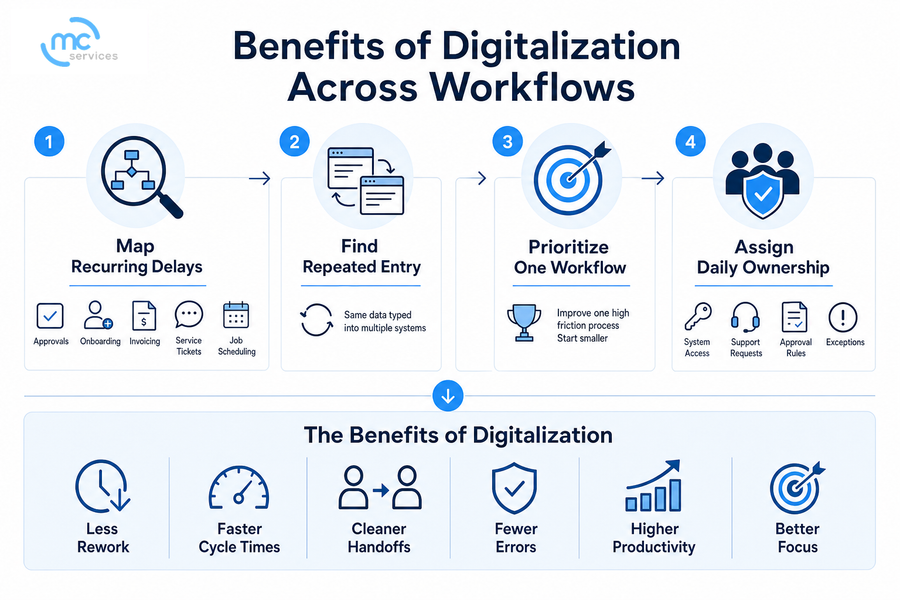
Map recurring delays: Start with approvals, onboarding, invoicing, service tickets, and job scheduling to see where work stops.
-
Find repeated entry: Identify where employees type the same customer, invoice, or job data into multiple systems.
-
Prioritize one workflow: Improve one high-friction process before expanding changes across departments.
-
Assign daily ownership: Clarify who manages system access, support requests, approval rules, and exceptions.
The benefits of digitalization show up when employees spend less time fixing rework and leaders get cleaner handoffs between teams, systems, and approvals. We do not recommend broad change for its own sake; the work should target delays that create ticket volume, missed deadlines, and preventable support burden.
Keep Exploring Digital Transformation
Digital Technology Benefits That Strengthen Communication
A team loses time when updates live in email, spreadsheets, voicemail, and individual devices. The project manager has one version of the job status, accounting has another, and the customer hears back after someone pieces the story together.
-
Shared visibility across teams: Centralized information reduces repeated status requests. Everyone can see whether a ticket, invoice question, or job update is open, assigned, or waiting on approval.
-
Clearer customer follow-through: Employees can see history, next steps, and ownership before responding, which helps prevent duplicate calls and inconsistent answers.
-
More consistent field updates: Mobile access helps field teams report job status, issues, photos, and documentation from the worksite instead of saving details for later.
-
Fewer avoidable escalations: Better routing and support records reduce confusion when a request moves from a front desk employee to a technician or manager.
-
Stronger device oversight: These digital technology benefits also depend on supportable devices. Our Apple and Jamf Certified Trainers and Certified Jamf Integrators help organizations manage Apple devices more consistently, which means fewer access issues, cleaner updates, and better support across locations.
Make Workflows Easier to Manage
MC Services helps connect your approvals, support, access, and communication tools so daily work moves with less friction.
Impact Of Digital Transformation On Risk And Cost Control
Risk grows when systems, access, approvals, and support processes are not clearly managed. A former employee with lingering file access, an untracked device, or a recurring ticket with no history creates avoidable exposure and extra support work.
Executives and managers should view transformation as an operating discipline, not only a software purchase. Digital technology implementation can accelerate progress toward business goals by 22% when the work is tied to process, oversight, and adoption.
-
Access is controlled: Role-based access helps reduce risk when employees change roles, join a new department, or leave the organization.
-
Support is documented: Ticket history helps identify repeat issues, training gaps, and systems that keep creating work.
-
Costs are easier to see: System visibility helps leaders understand subscriptions, devices, support needs, and workflow waste.
-
Change is less disruptive: Planning reduces downtime risk during migrations, device rollouts, and office transitions.
The impact of digital transformation is strongest when security, support, and cost control are managed together. Our certified security consultants, dedicated technicians, and on-site state-of-the-art data center support that discipline without treating risk management as a one-time setup.
Digital Transformation Benefits Start With The Right Support
Digital transformation benefits become practical when smoother workflows, stronger communication, reduced support friction, better continuity, and clearer cost control connect to how your teams actually work, from service tickets and file access to customer follow-up.
At MC Services, we bring responsive communication, dedicated technicians, certified security consultants, digital transformation services, website development services when relevant, and complex IT transition planning supported by experience with Great Lakes Roofing, Maynard Steel, and Halley Consulting Group.
We have supported over 157 businesses with a 98.55% customer satisfaction rating and over 100 years of combined expertise. Contact MC Services when you want tailored guidance from a one-stop provider that understands both inbox-level workflow issues and major IT transitions that affect continuity.

